by Justin Marquis
There have been turning points in my life that seem so small and trivial that I barely know what to do with them at the time, but as they linger for months and years, fermenting and aging, they become guidepost memories that orient everything that comes after them and reinterpret everything that came before. As I wrote in my last post, I experienced the time after leaving the church as one of liberatory awakening seeing the world as an open sea that I was now free to explore without artificial limitation. I’ve been debating what to say about that time of exploration and new found freedom. I soaked it up. I moved to a new city and read everything I could get my hands on. I experienced pleasures I denied myself and I started to see the world, both in a literal sense through study and travel and in a spiritual sense of recognizing the world as it might be from other perspectives than my own tiny narrow one. Both of those things matter, but the latter, the new spiritual eyes capable of seeing the world as if through the eyes of another is by far the more important and by far the more challenging. I’ve been debating what to say about bicycles too, as part of the reason for this blog is to set up why it is we are putting our things into storage, uprooting our lives, and setting out on the bike trail for months and months and months (though I kind of like this explanation for why bikes I wrote some time ago).
There is so much to say that I don’t know where to begin, which takes me to one of those guidepost memories, one of those memories that sticks there and remains with me, fermenting and changing me as I linger with it. The memory I have in mind takes me back to DC where I was teaching. The longer I’ve lived in big cities, the further I’ve had to live from my work, the affordable neighborhoods being distant from the neighborhoods where I can get work. DC was the first city where I really felt that; I lived an hour and a half commute by bike and train from the university where I taught three philosophy courses per semester. DC is one of those few places in America where the well-off and the privileged also take public transit, at least some of them do. The traffic is so bad and the public transit so good, that people would be stupid not to use it, even if they have an aversion to mixing with the prols and the poor. Like any public transit system anywhere in the world, there are plenty of prols and poor people on those metro seats, and many of those bodies and minds are tired. Tired from endless work. Tired from not having enough to pay the bills or feed the kids or afford an ounce of pleasure for oneself. Or if one does choose pleasure, something else slips, and they are just so tired. Having lived that grind myself, I know how it feels to be always tired from never having a moment to yourself without feeling like it is wasted unless you’re making money or getting something done. And so people sleep on public transit. Or they get lost in their music or TV on their phone. They zone out because the train getting them halfway across the city from the neighborhood they can barely afford to neighborhood that can afford to employ them is about all the time some of them get some days.
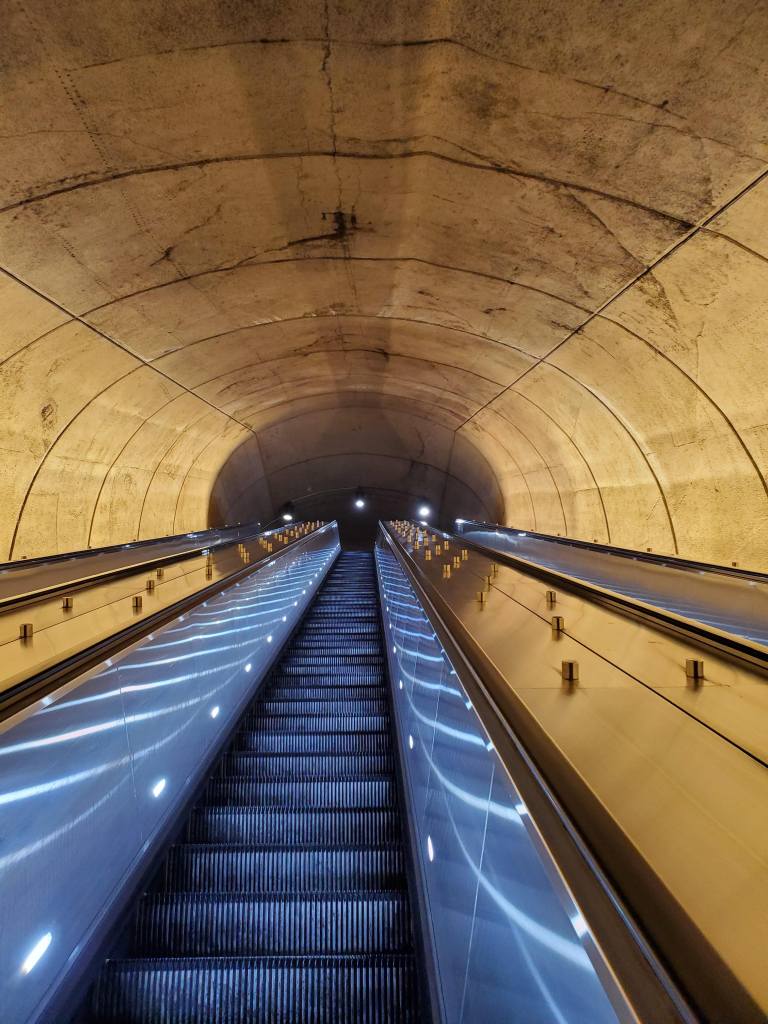
One day, on a train car with five or six of those exhausted souls longing for a break and drifting off to sleep, a train car was malfunctioning and the operator told everyone to get off at the next station because they were putting the malfunctioning train out of service. Several times, “Everybody off” in that garbled voice of the Metro car speakers. Two or three of those distracted or sleeping exhausted people didn’t hear the message and weren’t getting off the train. I did what I thought anyone would do. I went up to each of them. Tapped them on the shoulder. And told them to get off the train. It was simple. Easy. And I thought nothing of it. As I was leaving the train, successfully having gotten all the distracted people off as well, an older white man approached me. He had white hair and was dressed “professionally” and had a scowl. He told me that I shouldn’t help those people by warning them to get off the out-of-service train because they should have been paying attention. “They won’t learn any better if they have someone pay attention for them.” His lack of compassion and bitter disregard for the comfort and well-being of his fellow travelers was a jolt to me. How could he care so callously that they be paying attention at the right time? I was livid. And on that crowded train platform as we waited for the next train to replace the inoperable one we had just exited, I loudly excoriated the man whose callousness had just taken me by surprise, calling him out for his meanness to all within earshot. To him I seemed self-righteous; he dismissed me as a soapbox preacher, which at that moment I was. I was shaken by all of it, and it was the moment I knew that I could not stay in DC, that it wasn’t a home for me. But something else stuck with me from that day, something that changed me and moved me and made me the person I am today.
There are hundreds of thousands of men and women out there who would rather you suffer than lift a finger to ease your burden, the more so if you are poor or if you are marginalized in some other way. They will blame you when you fall, and say you should have been doing it all along when you manage not to once in awhile. There are people out there who think you should suffer to learn a lesson, suffer in ways they never have had to suffer. There are people out there, and they have so much power, who want to see you and me and lots of people like us and different than us, suffer and die. At the very best, they remain indifferent to it; at their worst, they are engineering a world where that’s the endgame. That man on the DC metro was just a glimpse into the mind of the indifferent powerful. I am “lucky” in that I am white and have an education. I can pass as petty bourgeois when I have to, and I can navigate that world as I have needed to. Others are not so lucky; others have it way harder than I do. What I know I cannot do is navigate the world as if that indifference and lack of hospitality to the poor and marginalized did not exist, and I cannot, insofar as I am able, live in ways that actively support that system and that hostility. I still have that impulse to be a soapbox preacher that I had on that DC subway that calls out those who say “no, they deserve what they get.”
Maybe what I learned, more than anything, on those open seas of discovery and exploration when the world became a place I could finally move about freely is this. Our world is a beautiful sea with many islands of pleasure and interest and deep wells of meaning that elicit in me wonder and gratitude. I urge everyone to travel the world by book, by conversation, by physical travel about the globe, and every other means as much and as widely as they can. It is the beautiful diversity of this planet and its people that constitutes some of the real value and interest in life. But what I also found on that open sea is the danger of those who rule us. Those who make us content with petty entertainments and enough pleasure to get through the day all while the marginalized are treated like that man on the DC metro treated those around me.
You might say I am exaggerating, that things aren’t that bad. That they could be worse, and maybe those people on the DC metro do need to learn a lesson. If you think that things aren’t that bad, then good for you. You do not live in Gaza. You are not poor. You are not unhoused. You are not black in a segregated city. You are not denied healthcare or dental work or enough nutritious food and the time to cook it. Be thankful for your blessings; I certainly am, but also know where you stand and what you have, and know that you did not earn it. Those who do not have these things, things we can so easily take for granted, did not earn their lot either. And if you think that maybe those people who do not have enough or are excluded in our society perhaps deserve it. If you believe that perhaps they need to learn a lesson for their laziness or their crime or where they were born, then you know why I am taking this bike trip.
If you hear in my words that the bike trip is a protest, perhaps you are right, it is a protest. But it’s more than that. It’s an attempt to live outside of a system that offers small entertainments and pleasures and comforts in exchange for my complacency. I am not happy with things as they are, even apart from those who are left further and further behind. The life I love is being made harder and harder to attain. So I am going to put my body to work on the bike trail in such a way that my mind can be free to think and meditate and imagine a better world is possible. This is a protest but a selfish one. No one in power cares what I have to say, and the protests after Ferguson and George Floyd show that protest doesn’t change anything anymore, certainly not in proportion to the risks. I don’t have the material means to support more than me and my partner working together. So I am protesting by finding joy in whatever pockets I can, meeting people, talking to them, seeing them where they are and being at their mercy as travelers on the road. It is only by connecting with others and finding each other who believe a different world is possible that we who have no power at all can begin to make a difference.
Bike touring is not like a car trip. When the furthest you go in a day is 80 miles but you average something more like 50 or 60, you linger in a place longer, get a feel for it. Bikes take you through a place instead of around it. You’re in river beds and industrial corridors, at the edges of neighborhoods and right through the heart of a downtown that last was thriving in the 1970’s. There is no way to see the America one can see by bicycle except by bicycle, and so I am taking that route as I try to make sense of the man on the DC subway who would rather people get what they deserve than lift a finger.
Along the route of the bike trip, I plan on going to church. Having read my series of blog posts on leaving the church, it might surprise you to learn that I plan on going back to churches while on the bike trail. It might surprise you that I am going back to church now. I still don’t have the words to fully articulate why that is or dare speak the reasons aloud. I do know that my return to the church is not what being in the church was during my evangelical fundamentalist days was. This pilgrimage, this protest, this attempt to find a different pleasure than the one the powers and system offer me now, out on the bike trail, this attempt to find others who share values that reject that system, all of this finds affinity in the Jesus of the gospels. I have to explore that connection of this protest and journey to the sacred and to the Jesus of the gospels. I do not know where it will lead, but as I find bridges over bike trails to rest and smoke under, as I find good food and places to camp in the spaces between cities, as I document this journey, I hope to find the Christians who see the same Jesus of the gospels, the Jesus who says to the exhausted worker on the train, “Get up, this train is out of service. Don’t be left behind. Let us wait for the next train.”
If you would like to hear one of my fumbling first attempts to give expression to my return to the church, you can listen to a sermon I gave Christmas morning here, or read this post here. I promise that this blog is not going to get more preachy than this post. Before we start delving into what I see on the bike trail this spring and what it shows us about America and myself, I want you the reader to know where I am coming from.
In the meantime, before we start this journey sometime May 2025, I want you to hear this message, “Get up, this train is out of service. Don’t be left behind.” This won’t lead everyone to a bike trip. It won’t lead everyone to a church. It won’t lead everyone to any place of worship. But each of us needs to find our bike trail and our church, whatever they may be. We need to find ways to live differently and live in a different kind of community with one another. What we’ve been doing isn’t working; that’s clear.
This protest pilgrimage is only one way of many that I’m conceptualizing this bike trip. The bike trip is also chance to see the country and the continent. It’s a chance to visit friends and family, I’d never get a chance to see otherwise. It’s preparation for the work and study that comes after as I prepare for seminary. It’s a chance to push my body before age takes away my ability to do this. It’s a chance to explore the spaces that few people get to see and document those spaces. And it is a chance to read and write about this experience along the way, a chance to maybe give expression to ideas about how different communities, different social worlds, and different ways of engaging with the spaces we inhabit are possible. Like I said, what we’ve been doing so far isn’t working.
 Dionysus on a Bike
Leave a comment